Why Tearing Down a Windermere Lakefront House Can Shrink What You're Allowed to Rebuild
October 15, 2026
October 15, 2026
On August 11, 2026, a homeowner on Ridgewood Drive went before the Windermere Town Council with a plan for the lot on Lake Down. The existing house was nonconforming, meaning it predates the current rules and doesn't meet them. The plan was to replace it with a two-story home of 5,360 square feet, including 3,900 square feet of living area, set 15 feet from the front property line and 40 feet from the lake's normal high-water elevation, with a pool 25 feet from that line. The town's Development Review Board had already recommended approval, 4 to 1. Council denied all three variances, 3 to 2.
For anyone thinking about buying an older lakefront house in the Town of Windermere to replace it, that vote matters more than any list price. The lot you're buying doesn't include the house's current footprint. What you can build is set by today's code, and the current footprint stops counting once you knock the house down.
Windermere lets nonconforming development stay as it is. The protection ends once the owner chooses to take it down. The relevant section of the Windermere Land Development Code says:
"If a nonconforming development or structure is voluntarily fully or partially demolished, any reconstruction must meet all requirements of this Land Development Code."
Town staff applied that rule in 2026 to a lakefront home and pool proposed for demolition and replacement. In practice, an older house sitting 30 feet from the water is a grandfathered asset only while it stands. Once it's demolished, the new house is measured against the full current setbacks, and the old house offers no precedent.
For lake lots, the main limit is the setback from normal high-water elevation, or NHWE. Windermere's setback text calls for 50 feet from NHWE for principal buildings and other structures. A separate resource-protection provision says no structure, accessory structures included, may sit within 50 feet unless the code provides otherwise.
Here's how that applies to the parts of a lakefront rebuild buyers usually care about most:
The front of the lot has limits too. The Ridgewood request started from a required 25-foot front setback. Windermere also caps impervious surface on residential properties at 45%, which counts pavers, drives, and decking along with the roof.
On a shallow lot, the 50-foot water setback and the 25-foot front setback squeeze the buildable area from both ends. The designer on the Ridgewood project, Dirk Arace, told Council the setbacks limit the depth available for the pool, house, and front porch, according to the West Orange Times & Observer. "Can a house be built? Yes, obviously," he said, but added that it "would be a two-story box."
Windermere's two most instructive recent lakefront cases went opposite ways, and the differences between the requests explain the outcomes.
| Case Z26-06, Ridgewood Drive | Case Z25-03, Main Street | |
|---|---|---|
| Lake | Lake Down | Lake Butler |
| Request | Front setback 25 to 15 ft; house 40 ft and pool 25 ft from NHWE, replacing a nonconforming house | Partial demolition and rebuild of a nonconforming pool and deck within 50 ft of NHWE |
| Development Review Board | Approved 4 to 1 | Recommended approval 5 to 1, with conditions |
| Town Council | Denied all three, 3 to 2, Aug. 11, 2026 | Approved 3 to 2, Nov. 11, 2025, after a motion to deny failed 2 to 3 |
| Conditions | None, since it was denied | Rear stormwater swales that capture at least one inch of runoff and include water vegetation |
The Main Street approval involved a smaller request. It rebuilt part of an existing pool and deck rather than placing a new, larger house closer to the water, and it came with a stormwater condition aimed at protecting Lake Butler. The Ridgewood request asked for relief on three dimensions at once, for a home larger than the 3,200 to 3,300 square feet the designer said is typical on Ridgewood Drive.
The council members who voted no explained their reasoning in public. Council member CT Allen said, as reported by the West Orange Times & Observer, "A lakefront lot is not a hardship. It's a beautiful piece of land, and I think you have to build to the lot." Council members Brandi Haines and Mandy David also said the request didn't meet all the criteria for approval.
Those criteria are written into the code. A variance requires positive findings that include a practical or economic difficulty, a motive beyond saving cost, no substantial harm to public safety or neighborhood character, consistency with the code's intent, and no encouragement of similar inappropriate requests. The lake view a buyer pays a premium for doesn't count as a hardship under that test.
The Ridgewood case shows a step in the Windermere process that's easy to underestimate. The Development Review Board's vote is a recommendation. The code gives the Town Council final authority to approve, modify, or deny what the board recommends. Both recent lakefront cases cleared the board comfortably, then were decided by 3 to 2 margins at Council, one going each way.
That makes a pending or recently granted board recommendation shaky ground for setting a price. A design that works only with a variance carries real risk until Council votes. On a lakefront lot, the difference between the approved and denied versions can be the pool, the porch, or a whole floor plan.
The setback is the visible limit. Wastewater is the one buyers tend to miss. The Town says more than 80% of homes on lakefronts and in lake basins use septic.
Windermere has studied sewer service but hasn't committed to it. In April 2024, Council approved a $373,830 Kimley-Horn wastewater study, paid from a $375,000 state appropriation, to assess converting 1,143 septic tanks to the Orange County Utilities system, as the West Orange Times & Observer reported. A later Town planning document says that agreement expired March 31, 2026, refers to the findings as complete, and proposes stakeholder review and a 10-year capital-readiness roadmap for a pressure-sewer network. The research found no construction vote, pilot area, or construction funding.
Under the Town's comprehensive plan, adopted May 12, 2026, owners must connect within one year once central sewer becomes available, and new development must use it where it's available. Until then, a lakefront rebuild is planned around a septic system, and septic has rules of its own. Florida law requires nitrogen-reducing systems, with at least 65% nitrogen reduction, on lots of one acre or less inside certain state water-quality plan areas where sewer isn't available. Orange County's guidance sets a similar enhanced-system requirement in its Priority Vulnerability Areas and ties variances from a 150-foot water-body setback to those systems. Whether a particular Windermere parcel falls inside one of those areas is a parcel-level question. So is whether a rebuild triggers a new septic permit. According to the Florida Department of Environmental Protection, a new-system permit is required where no system existed before and in certain complete-system replacements.
These septic distances are separate standards, measured from different lines, and they don't replace the Town's 50-foot NHWE building setback. Septic location came up in the Ridgewood discussion too, alongside impervious coverage and runoff. On a shallow lot, the drainfield, the pool, and the house can all end up competing for the same space between the street and the 50-foot line.
These are the facts that turn an older lakefront house's price into a rebuild budget:
Can I renovate an older nonconforming lakefront house instead of demolishing it? Windermere's code lets nonconforming development stay in use. Expansions or improvements have to fully comply with the code and can't increase the nonconforming condition. Voluntary full or partial demolition triggers the requirement to meet all current rules.
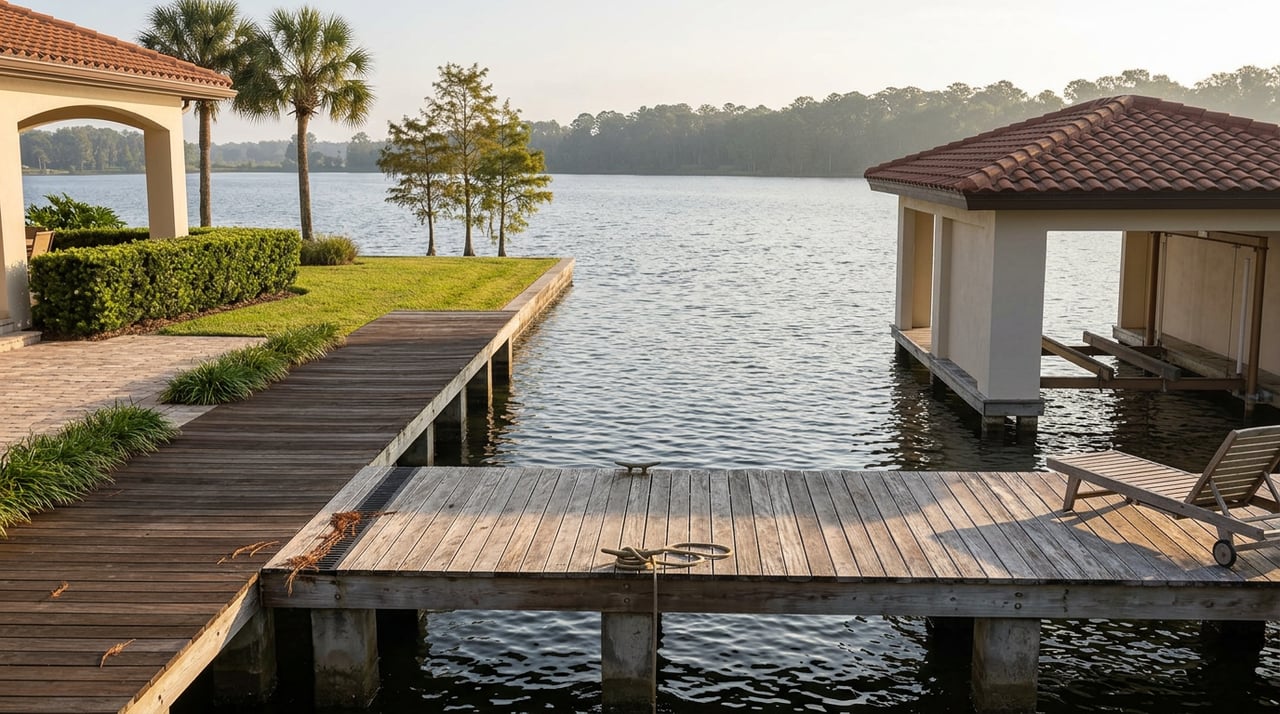
Do the setbacks affect my dock? The residential setback provision has a specific exception for boathouses and docks. Docks and boathouses still have their own siting and permitting standards.
Is sewer coming to Windermere's lakefront streets? The Town has finished a feasibility study and proposed a 10-year readiness roadmap, but as of October 2026 the research shows no construction vote or schedule.
If you're looking at an older lakefront house in Windermere with a rebuild in mind, CC Luxury Group can help you gather the survey, the setback math, and the septic history before you settle on a price. Schedule a Complimentary Luxury Consultation, and we'll go through what the lot actually lets you build.
This article is general information, not legal, tax or financial advice. Consult a qualified professional about your situation.
With over 20 years of knowledge, and $150 Million in real estate sold representing hundreds of transaction sides you can count on Crystal's experience. It is our goal as your full-service real estate consultants specializing in the Central Florida area, to provide you with superior service at all times.